How to Prevent Peptide Degradation Effectively
Peptides are remarkably powerful molecules, but they come with a significant vulnerability: they break down. Whether you’re working in a research lab or developing pharmaceutical peptides for therapeutic use, degradation is the enemy of accuracy, efficacy, and cost-efficiency. Understanding how to protect these fragile chains of amino acids is not optional — it’s foundational.
Peptide stability is influenced by a surprising number of variables. Temperature, pH levels, light exposure, enzymatic activity, and even the container material can all contribute to peptide degradation. The good news is that most of these factors are controllable with the right knowledge and protocols.
This guide walks through everything from structural modifications to peptide storage best practices, formulation strategies, and real-world handling tips. If you’re serious about preserving peptide integrity, you’ll find actionable guidance in every section below.
Understanding Peptide Degradation
Peptide degradation refers to the breakdown of peptide bonds and the overall loss of structural integrity in a peptide molecule. It can happen gradually or rapidly depending on environmental conditions and the peptide’s inherent chemical stability.
Common Causes of Degradation
Several mechanisms drive peptide degradation, and knowing them helps you build a better defense. Proteolysis, the enzymatic cleavage of peptide bonds by proteases, is one of the most common culprits in biological environments. Hydrolysis, oxidation, aggregation, and deamidation are also major contributors to instability.
The most damaging conditions are often the ones that seem minor, like a slight pH shift or a brief temperature spike during handling. These small deviations accumulate and compromise your peptide’s function over time.
| Degradation Type | Primary Cause | Affected Residues |
|---|---|---|
| Proteolysis | Protease enzymes | All peptide bonds |
| Oxidation | Reactive oxygen species | Met, Cys, Trp, His |
| Hydrolysis | Water, acidic or basic pH | Asp-Pro bonds |
| Aggregation | Hydrophobic interactions | Hydrophobic residues |
| Deamidation | Asparagine, glutamine residues | Asn, Gln |
Impact on Research and Applications
Degraded peptides produce unreliable data. In research settings, this means wasted reagents, skewed results, and repeated experiments that drain both time and budget.
In pharmaceutical peptides and therapeutic applications, degradation directly affects peptide half-life and patient outcomes. A peptide that breaks down before reaching its target site offers no clinical benefit and may even introduce unwanted byproducts.
Structural Modifications for Stability
One of the most powerful ways to combat degradation is to engineer stability directly into the peptide’s structure. These modifications don’t just slow breakdown — they fundamentally change how the molecule interacts with its environment.
Amino Acid Substitutions and D-Enantiomers
Natural L-amino acids are the primary targets of proteolytic enzymes. Substituting them with D-enantiomers creates a mirror-image structure that most proteases simply cannot recognize or cleave.
This approach is widely used in peptide synthesis to extend peptide half-life without significantly altering biological activity. It’s a clean, effective strategy that doesn’t require complex formulation changes.
Other substitutions include using non-natural amino acids or methylated residues, which add steric bulk around vulnerable peptide bonds and reduce hydrolysis susceptibility.
Cyclization and Stapling Techniques
Linear peptides are inherently more vulnerable than cyclic ones. Cyclization connects the peptide’s termini or side chains, creating a ring structure that resists enzymatic attack and improves chemical stability.
Stapling involves introducing a synthetic brace between two amino acid side chains, locking the peptide into a defined conformation. This not only improves proteolytic resistance but also enhances cell membrane penetration in therapeutic contexts.
- Head-to-tail cyclization reduces terminal degradation
- Disulfide bridges add structural rigidity
- Hydrocarbon staples improve alpha-helical stability
- Lactam bridges offer pH-stable conformational locking

Terminal Modifications and PEGylation
The N- and C-termini of peptides are prime targets for exopeptidases. Capping these ends with acetyl groups (N-terminal) or amide groups (C-terminal) blocks enzymatic access and significantly extends stability.
PEGylation, the attachment of polyethylene glycol chains to a peptide, is one of the most established oxidation prevention and proteolysis resistance strategies in pharmaceutical peptides. It also improves solubility and reduces immunogenicity.
PEGylation does come with trade-offs, including reduced receptor binding affinity in some cases, so it’s not universally applicable. The decision to PEGylate should be based on the peptide’s specific therapeutic or research requirements.
Storage and Handling Best Practices
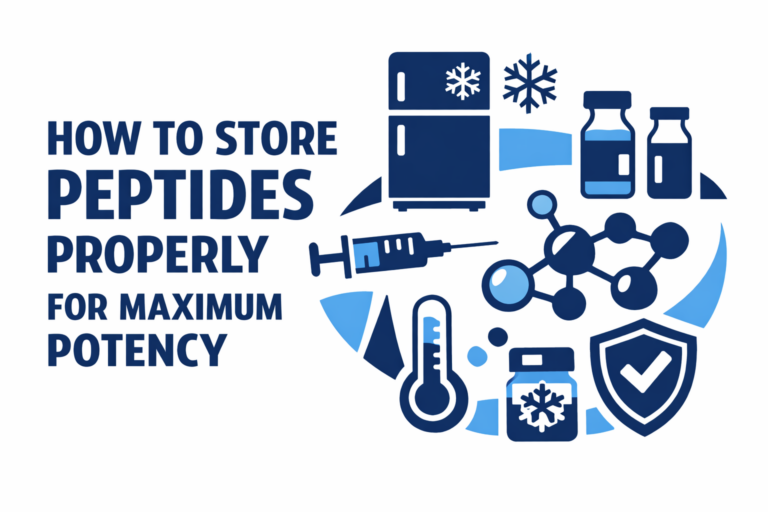
Even the most structurally robust peptide will degrade if stored improperly. Peptide storage protocols are not suggestions — they’re requirements for maintaining potency and reliability. For a comprehensive breakdown of storage protocols, this guide on how to store peptides properly for maximum potency covers everything you need to know.
Optimal Buffer and pH Selection
pH levels have a direct impact on peptide stability. Most peptides are most stable between pH 4 and 7, though this varies depending on the specific amino acid composition.
Buffer solutions should be chosen carefully to maintain this range without introducing reactive ions that could accelerate hydrolysis or oxidation. Phosphate and acetate buffers are commonly used for their stability and compatibility with most peptide sequences.
- Avoid buffers containing metal ions that catalyze oxidation
- Use low ionic strength buffers to minimize aggregation
- Match buffer pH to the peptide’s isoelectric point when possible
- Test buffer compatibility before large-scale storage
Lyophilization and Aliquoting
Lyophilization, also called freeze drying, removes water from the peptide sample under vacuum, converting it to a dry powder. This dramatically reduces hydrolysis and microbial degradation, making it the gold standard for long-term peptide storage.
Aliquoting before lyophilization is equally important. Dividing your peptide into single-use portions means you only expose what you need, reducing contamination risk and repeated handling stress.
Cold storage of lyophilized peptides at -20°C or -80°C further extends shelf life. Always use desiccants in storage containers to prevent moisture reabsorption after freeze drying.
Avoiding Freeze-Thaw Cycles
Repeated freeze-thaw cycles are one of the most underestimated causes of peptide degradation. Each cycle stresses the molecular structure, promotes aggregation, and can introduce ice crystal damage.
The solution is straightforward: aliquot your peptides into volumes that match your typical usage. This way, you thaw only what you need and never refreeze the remainder.
- Label aliquots clearly with concentration and preparation date
- Use cryoprotectants like trehalose or mannitol for sensitive peptides
- Allow peptides to reach room temperature before opening containers
- Never refreeze a thawed peptide aliquot
Formulation and Delivery Strategies
Structural modifications and storage protocols address stability at the molecular and environmental level. Formulation strategies take it further by physically protecting peptides during delivery and application.
Physical Embedding Methods
Encapsulating peptides within nanoparticles, liposomes, or hydrogels shields them from enzymatic degradation and harsh physiological conditions. These delivery vehicles act as protective shells, releasing the peptide only at the target site.
Peptide formulation using biodegradable polymer matrices is particularly effective for sustained-release applications. The polymer degrades slowly, releasing the peptide over time while protecting it from proteolysis and oxidation prevention challenges.

- Liposomal encapsulation improves circulation time
- PLGA nanoparticles offer controlled, sustained release
- Hydrogels provide localized delivery with minimal systemic exposure
- Cyclodextrin complexes improve solubility and chemical stability
Reconstitution methods also matter significantly. When you’re ready to use a lyophilized peptide, proper reconstitution with the right solvent preserves integrity. A detailed walkthrough on reconstituting peptides with bacteriostatic water provides a reliable step-by-step process for this critical step.
Practical Applications in Therapeutics
In therapeutic settings, peptide half-life and delivery efficiency determine clinical success. Enzyme inhibitors and protease inhibitors are sometimes co-administered to reduce in vivo degradation, particularly for peptides targeting the gastrointestinal tract.
Subcutaneous and intravenous delivery routes bypass the harsh digestive environment, preserving peptide integrity far better than oral administration. If you’re working with injectable peptides, understanding proper technique matters as much as formulation. Learning how to perform a safe subcutaneous injection is an essential part of any responsible peptide protocol.
Pharmaceutical peptides designed for oral delivery often require enteric coatings or mucoadhesive systems to survive the acidic stomach environment and reach the intestinal absorption site intact.
Conclusion
Preventing peptide degradation requires a layered approach. No single strategy is sufficient on its own, but combining structural modifications, proper peptide storage, smart formulation, and careful handling creates a robust defense against breakdown.
The science of peptide stability continues to evolve, and newer techniques in cyclization, PEGylation, and nanoparticle delivery are making it increasingly possible to develop peptides with exceptional durability. Whether you’re sourcing peptides for research or therapeutic use, starting with high-quality material is non-negotiable. Reviewing a peptide certificate of analysis before use ensures you know exactly what you’re working with from the start.
Apply these principles consistently, and you’ll see measurable improvements in peptide performance, data reliability, and cost efficiency across your work.
FAQ
What is the best storage temperature for peptides?
Lyophilized peptides should be stored at -20°C for short-term use and -80°C for long-term cold storage. Peptides in solution are far more vulnerable and should always be aliquoted, stored at -20°C, and never subjected to repeated freeze-thaw cycles. Cryoprotectants like trehalose can be added to solution-phase peptides to improve freeze-thaw resilience.
How does pH affect peptide stability?
pH levels directly influence hydrolysis rates and the ionization state of amino acid side chains. Extreme pH values, both acidic and basic, accelerate peptide bond cleavage and deamidation. Most peptides show optimal chemical stability between pH 4 and 7, though the ideal range depends on the specific sequence. Always use well-characterized buffer solutions and monitor pH regularly during storage and reconstitution.
Can all peptides be stabilized with PEGylation?
PEGylation is highly effective for many peptides, but it’s not universally suitable. Some peptides lose significant receptor binding affinity after PEG attachment, particularly those where the modification site overlaps with the active binding region. Smaller peptides may also experience disproportionate steric effects. The decision to use PEGylation should always be guided by activity assays and stability testing specific to the peptide in question.