How to Reconstitute Peptides with Bacteriostatic Water
Reconstituting peptides correctly is one of those skills that separates careful researchers from careless ones. Get it right, and you preserve the integrity of your compound. Get it wrong, and you risk degradation, contamination, or inaccurate dosing that renders your entire vial useless.
Most peptides arrive in powder form, specifically as lyophilized peptides that have been freeze-dried to extend shelf life and maintain stability during shipping. Before they can be used, they need to be dissolved in a suitable solvent. Bacteriostatic water is the gold standard for this purpose, and understanding why matters as much as knowing the steps themselves.
This guide walks you through the entire reconstitution process clearly and practically. Whether you are working with research peptides for the first time or refining your technique, the information here will help you handle your compounds with confidence and precision.
Understanding Peptides and Bacteriostatic Water
What Are Peptides and Why Reconstitute Them
Peptides are short chains of amino acids that serve as signaling molecules in the body, influencing everything from tissue repair to hormone regulation. They are supplied in powder form because lyophilization, or freeze-drying, dramatically improves peptide stability and extends usable shelf life.
In their dry state, lyophilized peptides are relatively stable. However, they cannot be administered or used in research until they are dissolved into a liquid solution through the reconstitution process.
Reconstitution simply means adding a sterile liquid to the peptide powder to create a usable solution. The goal is to dissolve the compound fully without damaging its molecular structure.
| Peptide State | Stability | Usability |
|---|---|---|
| Lyophilized (powder) | High | Not ready for use |
| Reconstituted (liquid) | Moderate | Ready for use |
| Improperly stored liquid | Low | Compromised |
Role and Benefits of Bacteriostatic Water
Bacteriostatic water is sterile water that contains 0.9% benzyl alcohol as a preservative. That benzyl alcohol content is what makes it superior to plain sterile water for peptide reconstitution.
The benzyl alcohol inhibits bacterial growth, which means your reconstituted solution stays protected from microbial contamination over multiple uses. This is critical when a single vial may be accessed repeatedly with a syringe.
Plain sterile water offers no such protection. Once opened and punctured, it becomes vulnerable to contamination almost immediately, making it a poor choice for peptides that will be used over days or weeks.
Peptide-Specific Considerations
Not every peptide dissolves easily in bacteriostatic water alone. Some compounds, particularly those with low solubility, may require a small amount of acetic acid or another co-solvent to fully dissolve before bacteriostatic water is added.
Always check the solubility profile of your specific peptide before beginning reconstitution. Forcing an insoluble peptide into solution incorrectly can cause aggregation and reduce effectiveness.
Peptide half-life and peptide stability also vary by compound. Some peptides degrade faster once reconstituted, which affects how quickly you should plan to use them after mixing.
Gathering Supplies and Preparation
Essential Tools and Materials
Having everything ready before you start prevents mid-process mistakes. Rushing to find a missing item mid-reconstitution increases contamination risk significantly.
Here is what you need:
- Lyophilized peptide vial
- Bacteriostatic water vial
- Insulin syringe (typically 1mL with fine gauge needle)
- Alcohol swabs
- Clean, flat workspace
- Optional: acetic acid for difficult-to-dissolve peptides
The insulin syringe is the preferred tool for this process because it allows precise measurement in small milliliter and microgram increments. Accuracy in drawing the correct volume of bacteriostatic water directly affects your concentration calculation later.
Sterilization and Workspace Setup
Your workspace should be clean, dry, and away from air vents or fans that could introduce airborne particles. Wipe down the surface with an alcohol swab before placing anything on it.
Contamination prevention starts before you even open a vial. Every rubber stopper on both the peptide vial and bacteriostatic water vial must be wiped with a fresh alcohol swab and allowed to air dry before needle insertion.
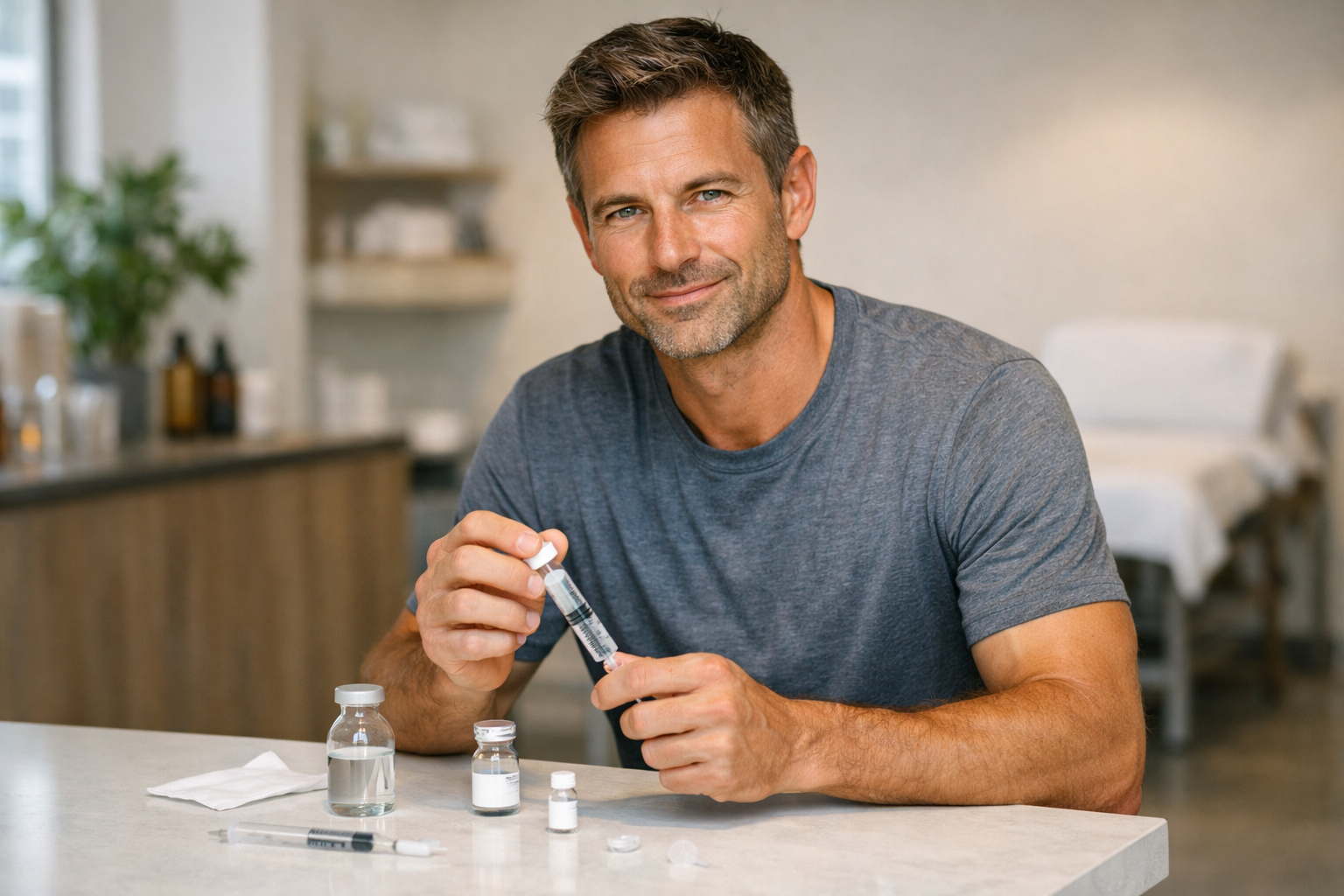
Never touch the needle tip or the cleaned rubber stopper with your fingers. Even brief contact introduces bacteria that can compromise your solution and create health risks during use.
Step-by-Step Reconstitution Guide
Drawing and Adding Bacteriostatic Water
Start by deciding how much bacteriostatic water you will add. This decision determines your final concentration, so think it through before drawing anything into the syringe.
A common starting point for a 5mg peptide vial is 1mL to 2mL of bacteriostatic water, but this varies based on your dosage needs. More water means a more dilute solution; less water means a more concentrated one.
Follow these steps precisely:
- Wipe the stopper of the bacteriostatic water vial with an alcohol swab
- Insert the insulin syringe needle through the stopper
- Draw the desired volume of bacteriostatic water slowly
- Remove the needle and wipe the peptide vial stopper with a fresh alcohol swab
- Insert the needle into the peptide vial at an angle
- Allow the bacteriostatic water to run slowly down the inside wall of the vial
Never squirt the liquid directly onto the peptide powder with force. Directing the stream gently along the glass wall prevents foaming and reduces the risk of peptide degradation from mechanical stress.
Mixing Techniques: Swirl, Don’t Shake
Once the bacteriostatic water is in the vial, resist every instinct to shake it. Shaking creates bubbles and can physically damage the peptide’s molecular structure through agitation.
Instead, gently swirl the vial between your fingers using slow, circular motions. If the powder does not dissolve immediately, allow the vial to sit for a few minutes and swirl again.
Patience here protects your investment. Most lyophilized peptides dissolve within a few minutes of gentle swirling. If yours does not, it may require a small amount of acetic acid added first to improve solubility before the bacteriostatic water is introduced.
Some peptides may appear slightly cloudy initially. Continue swirling gently until the solution becomes clear. A persistently cloudy solution may indicate a solubility issue that needs to be addressed differently.
Determining Dosage and Concentration
Dosage calculation is where many people make errors. Getting this right requires simple math, but it must be done carefully.
If you added 1mL of bacteriostatic water to a 5mg peptide vial, your concentration is 5mg per mL, or 5000 micrograms per mL. Since an insulin syringe typically holds 100 units per mL, each unit equals 50 micrograms.
Here is a quick reference for concentration calculation:
- 5mg peptide plus 1mL water equals 5000mcg per mL
- 5mg peptide plus 2mL water equals 2500mcg per mL
- 10mg peptide plus 2mL water equals 5000mcg per mL
Write down your concentration immediately after reconstitution. Relying on memory for dosage calculation is a common and avoidable mistake. Before sourcing your compounds, reviewing trusted suppliers for research-grade peptides ensures you start with quality material that reconstitutes predictably.
Common Mistakes, Storage, and Safety
Avoiding Pitfalls and Errors
The most frequent mistake is shaking the vial vigorously. This causes foaming, introduces air bubbles, and can denature the peptide, reducing its effectiveness significantly.
Another common error is using the wrong solvent. Using tap water or non-sterile water introduces immediate contamination risk. Only bacteriostatic water or appropriate pharmaceutical-grade solvents should be used.
Watch out for these additional mistakes:
- Skipping alcohol swab sterilization on vial stoppers
- Using a dull or previously used needle
- Adding water too quickly or with too much force
- Failing to label the vial with concentration and date
- Storing reconstituted peptides at room temperature
Understanding what you are working with also matters. Before reconstituting any compound, knowing how to verify its quality is essential. Learning how to interpret a peptide certificate of analysis helps you confirm purity and identity before you ever open the vial.

Post-Reconstitution Storage Guidelines
Once reconstituted, peptides must be refrigerated immediately. Room temperature accelerates peptide degradation and shortens the usable window of your solution considerably.
Store your reconstituted vial in the refrigerator at approximately 2 to 8 degrees Celsius. Keep it away from the door where temperature fluctuations are more common.
For detailed guidance on maintaining potency over time, following proper peptide storage protocols is one of the most impactful steps you can take to protect your compounds. Proper refrigeration combined with bacteriostatic water’s preservative properties gives reconstituted peptides a reasonable window of stability.
Never freeze a reconstituted peptide solution. Freezing causes ice crystal formation that can physically damage the peptide structure and reduce its effectiveness. Lyophilized powder can be frozen, but liquid solutions cannot.
Safety Precautions and Perspectives from Experts
Peptide reconstitution involves needles, sterile compounds, and injectable solutions. Treating every step with appropriate care is non-negotiable.
Always use a new, sterile insulin syringe for each draw. Reusing needles introduces contamination and dulls the needle tip, making any subsequent injection site use more uncomfortable and less precise.
Experts in peptide research consistently emphasize the importance of sourcing quality compounds from verified suppliers. Contaminated or mislabeled peptides create risks that no amount of careful reconstitution technique can overcome.
If you are researching specific peptide compounds and their sourcing options, understanding the legal framework matters too. Reviewing the legal considerations for purchasing research peptides in the USA keeps your research compliant and your sourcing decisions informed.
Dispose of used needles in a proper sharps container. Never recap needles by hand, and never leave used syringes on open surfaces where accidental needle sticks can occur.
Conclusion
Reconstituting peptides with bacteriostatic water is a straightforward process when approached methodically. The key principles are simple: use sterile technique throughout, add water gently along the vial wall, swirl rather than shake, calculate your concentration accurately, and refrigerate immediately after mixing.
Bacteriostatic water’s benzyl alcohol content makes it the preferred solvent for multi-use vials, offering protection against bacterial contamination that plain sterile water cannot provide. Combined with proper storage and careful handling, it gives your reconstituted peptides the best possible stability window.
Every step in this process serves a purpose. Skipping even one, whether it is wiping a stopper or labeling your vial, introduces risk that compounds over time. Treat each reconstitution as a precise, repeatable procedure and your results will reflect that care.
FAQ
How much bacteriostatic water should I use for a 5mg peptide vial?
The amount depends on your desired concentration. Adding 1mL gives you 5000mcg per mL, while adding 2mL gives you 2500mcg per mL. Choose the volume that makes your target dose easiest to measure accurately with an insulin syringe.
Can I use regular sterile water instead of bacteriostatic water?
Sterile water can be used for single-use reconstitution, but it offers no protection against bacterial growth after the vial is opened. Bacteriostatic water, with its benzyl alcohol preservative, is strongly preferred for any vial that will be accessed multiple times over days or weeks.
How long does reconstituted peptide last in the fridge?
Most reconstituted peptides remain stable for several weeks when stored properly in the refrigerator at 2 to 8 degrees Celsius. Peptide stability varies by compound, so always research the specific half-life and degradation profile of your peptide. Peptide degradation accelerates at higher temperatures, so consistent refrigeration is essential for maintaining potency throughout the usage period.